How One Lifeboat Could Redefine the RNLI’s Entire Fleet
Background
For two centuries, the Royal National Lifeboat Institution (RNLI) has been the UK and Ireland’s frontline of rescue at sea. Every launch is powered by donations, every boat crewed by volunteers, and every design decision is judged on how best to keep people safe, use resources wisely, and deliver the RNLI’s lifesaving mission.
In 2024, the RNLI joined the MarineShift360 Impact Accelerator, a year-long programme helping marine organisations embed lifecycle thinking to future-proof decisions and unlock efficiencies.
For the RNLI, it offered the structure, data support, and collaborative environment to explore a pressing new question: how can the charity protect people at sea while minimising its environmental impact, without compromising safety, speed, or service?
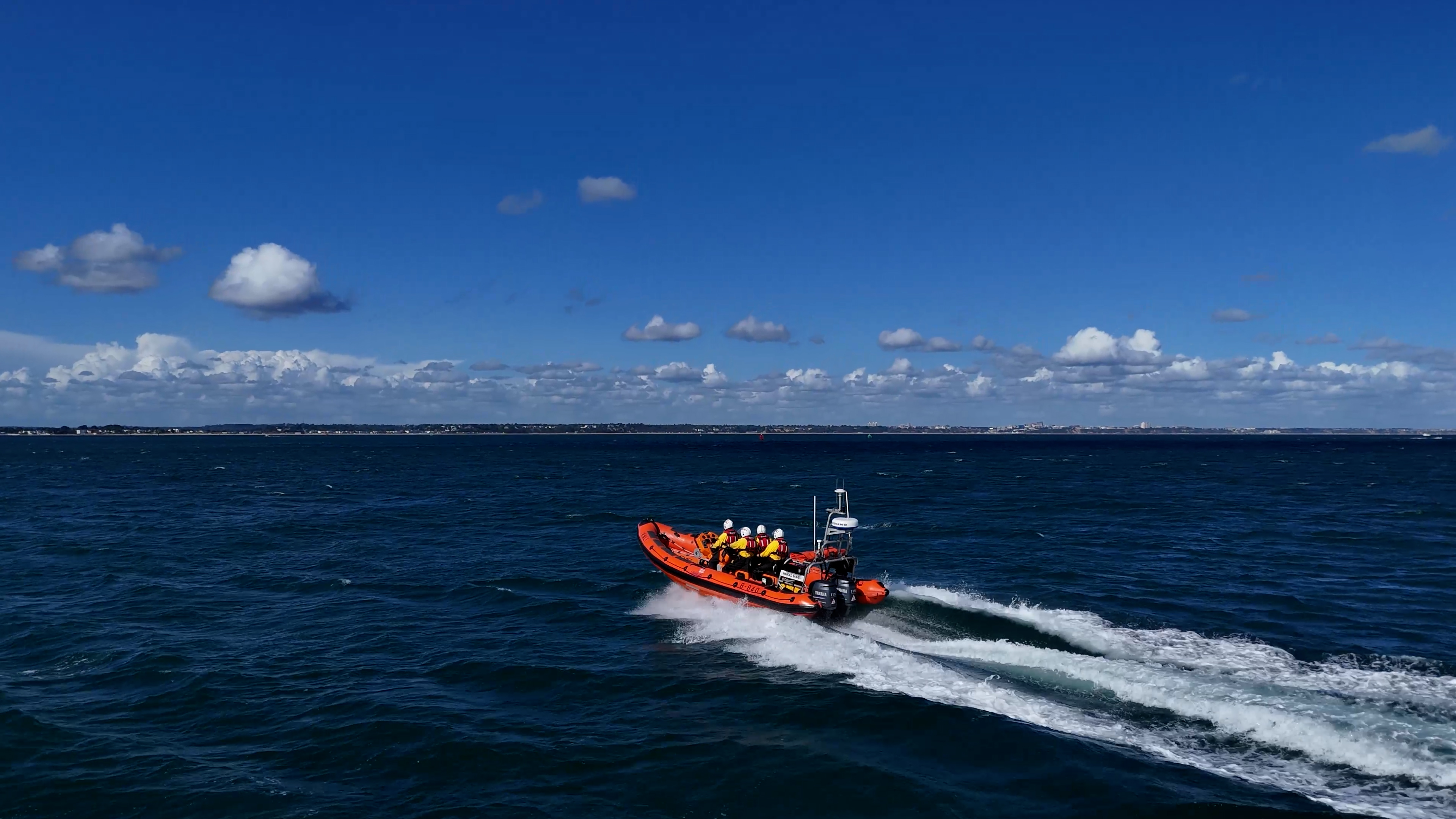
The Atlantic 85, a fast, agile and widely deployed lifeboat, was chosen as the pilot platform. By putting it through a full lifecycle analysis (LCA), the RNLI aimed not only to understand a single boat, but to develop a repeatable method that could guide design and procurement decisions across its entire fleet.
The Challenge
At the outset, the RNLI weren’t certain where the biggest opportunities to reduce impact would lie. Production seemed the most likely area, given how energy and material intensive boatbuilding is, involving composites, metals, electronics and factory power. But only the data could confirm or challenge that view.
The task was to prove, with robust data and a holistic model, where to focus attention. Was the greatest opportunity in reducing carbon fibre use, upgrading processes in lifeboat production, or switching to higher-recycled materials?
As Sean Deasy, Energy Manager at the RNLI, said: “Early on, we assumed the biggest opportunities would sit within production. Once we saw the full picture, it became clear that our focus needed to shift. The data challenged some of our assumptions and helped us direct effort where it will have the greatest impact.”
The Approach
The project was scoped cradle-to-grave, covering an 18-year service life for a representative Atlantic 85. This included raw material extraction, manufacturing , fit-out, operations, maintenance, and end-of-life.
A big step forward was bringing together datasets that had never been fully reconciled. Return-of-service logs, AIS tracking, and digital simulations were aligned with factory energy use, material flow data, and supplier information. This gave a much richer, more accurate picture of the vessel’s true footprint.
Within production, the A85’s energy demand was mapped and modelled alongside material inputs such as glass and carbon fibre composites, resins, aluminium, stainless steel, and drivetrain components. Fuel use was modelled at the highest possible resolution, with sensitivity analyses run to reflect different station duty cycles.
“It took real effort to pull the data together,” Deasy said, “but the result is a much more robust dataset that gives us a clearer picture now and sets us up well beyond this initial project.”
What began as a technical exercise quickly became a lesson in where the RNLI’s greatest environmental impact lies.
Note on scope: End-of-life treatment of the vessel itself was omitted (retired boats are sold on); only composite waste from manufacturing is included.
The Results
When the numbers came back, the story was clear, and it wasn’t the one the RNLI expected.
The analysis confirmed that over an 18-year lifespan, around 82% of an Atlantic 85’s lifecycle impact comes from the use-phase, with only 18% coming from production.
The surprise was just how much variability there was. Depending on where and how the Atlantic 85 operates, lifetime emissions can differ by up to six times, a swing driven almost entirely by duty cycle.
“They’re beautifully maintained and always ready,” said Todd Gillingham, ES PMO & Resource Lead at RNLI. “You can fall into the trap of thinking we don’t actually use them that often. But once we crunched the numbers, we realised we’re using them more than we believed, and that has a big impact.”
Production wasn’t irrelevant, but the hotspots told their own story. Mouldings accounted for a third of production impact (34%), largely due to carbon fibre and epoxy. Together, those two materials drive roughly 60% of the mouldings footprint.
One surprise was that carbon fibre still played such a significant role. The RNLI had phased out full carbon fibre hulls years earlier, assuming the material was no longer a major factor. But the LCA revealed it was still embedded in laminates, quietly driving up embodied carbon.
Other production factors included energy use (23% of production impact), fit-out and rigging (18%) and the drivetrain (18%, primarily the Yamaha F115 engine).
Together, these findings shifted the RNLI’s perspective. Fuel use doesn’t just dwarf production, it defines the overall footprint. And if that’s true for the Atlantic 85, it will matter far more for the RNLI’s larger classes like the Tamar, where fuel burn, and therefore both cost and carbon, is many times higher.
What Changed: From Insight to Impact
“Without this study, it’s difficult to say where to put our efforts. With it, we can prioritise, and reduce the impact.” said Todd Gillingham.
The RNLI is now acting on three fronts:
- Operational efficiency first
The Mark 4 design team is exploring fly-by-wire throttle controls and helm feedback systems to align power curves with real use patterns, particularly at sub-7 knots, where the boats operate most often. These efficiency measures will inform training and design guidance across all lifeboat classes. - Production optimisation
Efforts are underway to reduce reliance on carbon fibre, explore bio-resins and natural fibres, and specify higher-recycled aluminium and stainless steel in structural components. As part of the RNLI’s ESOS obligations, the organisation is also reviewing the energy efficiency of its production facilities to identify further opportunities for improvement. - Scaling the method across the fleet
The biggest opportunity lies ahead. The Atlantic 85 established the framework; the larger classes will prove its value. The RNLI now has a data-driven decision-making method to inform million-pound decisions, from whether to life-extend or rebuild to evaluating alternative propulsion or fuel options.
Driving Efficiency and Value
The findings are already shifting investment priorities. Because fuel is both the largest carbon source and the largest operating cost, every litre saved cuts emissions and expenditure, a simple rule that helps teams target the highest-value interventions first.
“Some people will shudder when you say sustainability,” Todd Gillingham admitted. “But if we can show the efficiency gains and the money you could save in fuel, that’s a big one to go straight after.”
The Atlantic 85 has also provided the RNLI’s leadership team with a template for smarter financial decisions across the fleet. By quantifying impact, the LCA now underpins investment choices around refits, replacements, and technology upgrades, helping ensure every pound donated delivers maximum value.
Beyond the Numbers
For the RNLI, environmental impact is now inseparable from operational efficiency and financial responsibility.
“We’re a charity. All of our funding comes from supporters,” Todd Gillingham explained. “We need to demonstrate we’re using that money effectively to provide our service. Better for the environment, better for society, and funded responsibly.”
The project is also reshaping culture. Engineers, designers, and operations staff are beginning to view sustainability not as a separate goal, but as part of performance and service delivery.
By reframing sustainability as both an environmental and a cost-efficiency challenge, the LCA has broadened engagement across the organisation, from technical teams to finance and operations.
What’s Next
The Atlantic 85 Mark 4 will move through prototyping in Q1 2026 and performance trials in Q2 2026, with every design choice benchmarked against the LCA baseline. Beyond that, the RNLI will extend lifecycle analysis to its larger boats, starting with the Tamar-class, where operational impact is far higher but so is the potential for reduction.
What began as one vessel’s assessment is now evolving into a fleet-wide strategy, helping the RNLI cut emissions, save fuel, and strengthen the sustainability of its lifesaving mission.
What started with one boat could now redefine how the RNLI, and the wider maritime rescue community, design for the future.
What This Means for the Industry
The Atlantic 85 study shows the value of data-driven decision-making. By quantifying impacts across production and operation, the RNLI has a clear picture of where to focus its efforts.
It also highlights how much duty cycle dictates design. The same class of vessel can vary six-fold in emissions depending on how and where it is deployed. Without localised data, organisations risk designing for averages that don’t reflect reality.
Perhaps most importantly, the Atlantic 85 proves how one pilot can steer a fleet. By establishing a robust method on a single boat, the RNLI now has a template that can be applied to larger classes such as the Tamar, where the stakes and the savings are far greater.
And finally, the findings underline that sustainability and efficiency go hand in hand. The same changes that reduce carbon also save fuel and operating costs, reinforcing that environmental responsibility is not an add-on, but a smarter way to run a service.
Ollie Taylor, Director of MarineShift360 said: “These tools allow you to test the trade-offs that really matter: do you keep an existing vessel running, or invest in a new drivetrain that’s more efficient over its lifetime? That kind of analysis is only possible with a lifecycle view. By taking this step, the RNLI is really setting the example for the whole maritime sector and proving how data-driven design can cut emissions, save money, and reshape how fleets are managed for the future.”
.jpg)